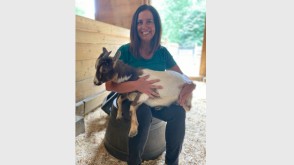
This March, in celebration of Women’s History Month, Bay Path University will spotlight the inspiring women who help shape our community and beyond. Each week, we will share the story of a community member who is making a meaningful impact in her profession, her community, and within the University.
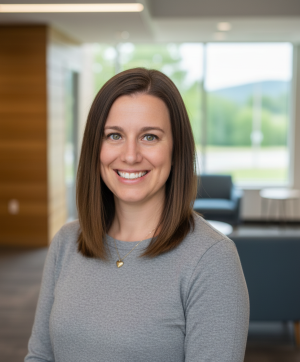 For Sarah Tsitso, impact is measured not just in numbers, but in lives both human and animal. Over the past decade, she has helped transform the Zoo in Forest Park in Springfield, MA, into a financially stable, mission-driven organization rooted in conservation, education, and rehabilitation. Today, the zoo at 125+ years is not only thriving but also redefining what modern zoos can be—places where injured, abandoned, and non-releasable animals find lifelong care and where visitors leave with a deeper understanding of their role in protecting wildlife.
How long have you been at the zoo?
This is my 10th season. It’s incredible to think about how much we’ve accomplished in that time.
What degrees did you earn?
I earned my undergraduate degree from Simmons College in Boston. I later completed an MS in Nonprofit Management & Philanthropy in 2009 and, most recently, an MFA in Creative Nonfiction Writing in 2024.
What sparked your interest in working at Forest Park Zoo?
I grew up in Western Massachusetts and had always known the zoo. Like many in the region, I also knew it had struggled. When the board president approached me, he explained that the organization was at a turning point. Some believed it could be revitalized, and they were looking for someone with a nonprofit and strategic perspective to help determine whether that was possible.
I joined initially as a consultant for six months. The board’s commitment to preserving this community resource for future generations was inspiring. At the end of that period, I believed we could rebuild if we worked together toward a shared vision. I accepted the executive director’s role, and we’ve been moving forward ever since.
Today, the zoo has operated in the black for five consecutive years, attendance and community engagement are strong, and we were recently named to the Super 60 by the Springfield Regional Chamber. I’m incredibly proud of what our team has accomplished.
What is a typical day like for a zoo director?
There really isn’t one. Animals are a lot like children, every day is different. Our zookeepers are outside in every kind of weather, making sure the animals are safe, comfortable, and cared for. My role is to support them, advocate for resources, and tell the story of why this work matters.
One day I might be meeting with donors. Or I’m running the business side of things. The next, I’m checking in on an animal that just arrived after being injured in the wild or helping share their story with the public. It’s unpredictable, but it’s incredibly meaningful.
How are zoos adapting to climate change and conservation challenges?
Zoos today are evolving, and we’ve embraced that shift. Several years ago, we completely reimagined our mission around three core pillars: conservation, education, and rehabilitation.
We now focus primarily on native and climate-appropriate species that are non-releasable. These animals may have been orphaned, injured, or permanently disabled due to human activity. Some were kept illegally as pets. Others come from facilities that have closed and cannot survive in the wild. We don’t buy or sell animals. Instead, we partner with wildlife rehabilitation organizations to give these animals a safe, enriching home.
Visitors may notice that our zoo looks different than it did decades ago. Instead of large, exotic animals like elephants and lions, they’ll see animals whose stories connect directly to the community, animals that help us teach responsible coexistence with wildlife.
What are some of the animal stories that stand out to you?
Many of our animals are powerful reminders of how human behavior impacts wildlife. For example, we have a serval, a wild African cat, which was kept illegally as a pet. He was declawed before coming to us, which means he could never survive in the wild. His story helps us educate visitors about the dangers of the exotic pet trade.
We also care for animals that have lost limbs, eyesight, or the ability to hunt. Visitors might see a three-legged coyote or a one-eyed owl—animals that now serve as ambassadors for conservation and compassion.
One of my favorite educational moments involves a porcupine who can no longer live in the wild because she became too accustomed to humans feeding her. Her story helps people understand why even well-intentioned actions can harm wildlife.
We also share lighter moments. One Thanksgiving, a domestic turkey appeared in the park and simply joined our free-range pea hen and peacock flock. She blended right in and became a social media sensation. It’s a reminder that animals and people can sometimes find belonging in unexpected places.
What initiative are you most proud of?
Empowering our staff. We have incredibly talented and passionate people and giving them a voice has led to many of our most impactful programs.
I’m also proud that we’ve stabilized this organization and preserved it for future generations. Seeing children coming back year after year who know the animals by name, and connect with their stories, reminds me why this work matters.
What is your favorite animal?
I get this question all the time. Cheese the rooster is definitely a favorite and has become our unofficial mascot. He’s everywhere: on our social media and even in media interviews.
I also love watching our beavers, Justin and Cedar. They’re endlessly entertaining and fascinating to observe. And Farrah, our Bactrian camel (these camels are native to Asia and can handle cold), has an incredible story. She had serious medical challenges as a baby and nearly didn’t survive. Today, she’s healthy and thriving, though she has a very big personality and definitely enjoys being the center of attention.
How did your Bay Path degree prepare you for your career?
My degree gave me the tools to lead a nonprofit organization. I learned financial management, strategic planning, and how to work with a board of directors. Running a nonprofit is very much like running a business, the difference is that mission drives every decision.
And the financial management course I once dreaded is now one of the most valuable parts of my education. I use those skills every day.
What advice would you give students interested in nonprofit leadership?
Be curious, ask questions, and learn from everyone around you. Whether someone is a senior leader or a volunteer, they all bring a unique perspective. Nonprofit work is challenging but incredibly rewarding.
What continues to inspire you?
Every day something happens that makes me laugh or reminds me why this work matters. You just have to be open to those moments. Finding joy in the ordinary and the unexpected keeps me inspired.